+86 15093323284 hams@ailunce.com




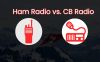
CB Radio vs Ham Radio: Functions, Licensing & Scenarios

What Is CB Radio? – A License-Free Civilian Communication Tool
CB Radio (Citizens Band Radio) is a short-range radio service that does not require a license in many countries (including the US). It operates on the 11-meter band around 27 MHz and has 40 fixed channels (early models had 23). Most CB radios use AM (Amplitude Modulation) , though some support SSB (Single Sideband).
Key Features
No license required – Anyone can buy and use it (within power limits).
Power limit – Legally capped at 4 watts (carrier power) in the US, which limits range.
Very easy to use – Select a channel and start talking; almost no learning curve.
Typical users – Truck drivers (for traffic updates), off-road beginners, families for short-distance contact.
Real user feedback (truck driver) :
“I keep my CB on Channel 19. I don’t even talk – I just listen. I get real-time alerts on accidents, construction, and police activity. It’s much safer than looking at my phone while driving.”
Limitations
Short range – A few miles under ideal conditions; less in cities.
AM noise – Prone to static and interference from electrical devices.
Chaotic channels – Some channels (e.g., Channel 6) are notorious for illegal high-power jamming, music playing, and arguments, making normal conversation difficult.
What Is Ham Radio? – Licensed, Experimental, Global Communication
Ham Radio (Amateur Radio) is a licensed radio service regulated by the FCC (in the US) or similar bodies worldwide. Operators must pass an exam to obtain a call sign before transmitting. Amateur radio is not for commercial use – it encourages technical experimentation, emergency communication, and international friendship.
Key Features
License required – Pass a test (Technician / General / Extra in the US) and get a call sign.
Multiple bands – From 135 kHz to several GHz, including HF (shortwave), VHF, and UHF.
Multiple modes – FM, AM, SSB, CW (Morse code), digital modes (FT8, PSK31), even email and satellite relay.
Higher power – Legally up to 100 watts on VHF/UHF and 1,500 watts on some HF bands (depending on license class).
Clear audio – FM mode is clean and free of the static typical of AM.
Real user feedback (former CB user) :
“The first time I used FM on ham radio, I was shocked. It sounded like switching from an AM radio to a CD. And with a local repeater, my handheld covered the entire city – something my CB could never do.”

Requirements & Responsibilities
Study and pass an exam – Learn basic electronics, regulations, and operating practices.
Identify with your call sign – Required every 10 minutes or at the end of a contact.
Self-policing – Ham bands generally have good order and few intentional
Detailed Comparison: CB Radio vs Ham Radio
|
Aspect |
CB Radio |
Ham Radio |
|
License |
None required |
License and call sign required |
|
Typical Band |
27 MHz (11 meters) |
HF, VHF, UHF (many bands) |
|
Modes |
Mostly AM, some SSB |
AM / FM / SSB / CW / Digital |
|
Max Power (US) |
4 watts (carrier) |
Up to 1,500 watts (depending on license) |
|
Typical Range |
A few miles (ground wave) |
Global (via ionosphere or repeaters) |
|
Entry Cost |
~$50-60 for handheld |
~$75-80 for basic handheld |
|
Ease of Use |
Extremely easy – pick a channel and talk |
Moderate – requires programming and learning |
|
Typical Users |
Truckers, off-road beginners, families |
Hobbyists, emergency volunteers, explorers |
|
Air Environment |
Some channels are chaotic with jamming |
Generally orderly and self-regulated |
Which One Should You Choose? – Scenario-Based Advice
Choose CB Radio if:
You only need short-range communication (a few miles) with friends on the trail.
You do not want to study or take a test – just open the box and talk.
You mainly want to listen to local traffic updates (e.g., trucker channel).
Your entire group already uses CB and has no plans to upgrade.

Choose Ham Radio if:
You need longer range (city-wide, national, or even global).
You want clear, static-free voice quality (FM mode).
You are genuinely interested in how radio works – antennas, propagation, digital modes.
You want a more reliable emergency communication tool (after learning to use it).
Your off-road club or emergency team requires ham radios.
A Sensible View: You Can Have Both
Many experienced users recommend keeping both.
One outdoor enthusiast shared: “I have a CB permanently installed in my truck for local traffic and CB convoys. I also carry a small ham handheld to reach repeaters when I’m out of cell range. They don’t compete – they complement each other.”
Common Misconceptions
Myth 1: “Ham radios are too expensive. CB is cheaper.”
Reality: Entry-level ham handhelds (like the Baofeng UV-5R) cost about $75, while basic CB handhelds are around $50-60. The price difference is small, but ham offers far more capability.
Myth 2: “The license is a hassle, and I don’t want to be on a government list.”
Reality: The US Technician exam has only 35 questions. You can study online and take a local test – many people get licensed in a few weeks. And your information is already on many lists (driver’s license, credit cards, etc.). This fear is largely outdated.
Myth 3: “In an emergency, I can use any frequency without a license.”
Reality: US law does allow using any frequency to save life or property in a genuine emergency. But if you have never learned how to operate a ham radio, you may not be able to call for help effectively when it matters. Learning and getting licensed beforehand is responsible preparation.
Conclusion: A Choice Based on Experience and Expertise
So, CB radio vs ham radio – which is better?
The answer depends on your needs, your group, and how much you want to learn.
CB radio is a low-barrier, simple, practical tool for local, non-technical communication. It works well for short-range chats.
Ham radio is a gateway to global communication and technical discovery. It requires some study, but rewards you with greater range, cleaner audio, and a wider community.
If you just want to chat with your buddies in the next vehicle on a weekend trail ride, CB is fine.
But if you feel even a small curiosity about how radio works and are willing to spend a few weekends learning, ham radio will open a fascinating new world.
As one user who started on CB and now holds a General license put it:
“I’m grateful to CB for getting me started. But ham radio made me fall in love with radio. The feeling of talking clearly with someone on the other side of the world using 10 watts and a wire antenna – that’s something CB could never give me.”
References & Further Learning
US license exam prep: hamradioprep.com
Practice tests: QRZ.com
Find a local club: ARRL.org
Whichever path you choose, use the airwaves legally, respectfully, and enjoy the journey.